
You’re about to drop over $15,000 on a ducted air conditioning system. Then you suddenly notice the first power bill and realise something is wrong.
And here’s what most homeowners miss: they focus on the purchase price and ignore these hidden costs entirely.
Our ducted aircon buying guide reveals what installers won’t mention to you during a quote. You’ll learn here:
- The sizing mistakes
- Running costs
- Zoning decisions
These basics can make you a wiser buyer than a regretful one. So, ready to dig in?
How To Calculate The Right Ducted Air Conditioning System Size
We’ve seen most installers use this simple formula: 0.15 to 0.16 kilowatts per square metre. This simply measures your floor space and provides you with a corresponding number.
However, this method overlooks the more important aspects. Your ceiling height can change the overall calculation. Meanwhile, the quality of your insulation affects the cooling capacity you need. Window size and direction also make a massive difference.
Did you see those single-glazed windows? It loses three times more heat than double-glazed ones. You can add 30% more cooling capacity just to fight the heat coming down from your roof space. Choosing west-facing windows in your living room can add another 2-3 kilowatts to your total load.
Once you get these measurements wrong, you’ll pay for it later.
One homeowner installed a 16kW reverse-cycle air conditioner when he needed 22kW. His system ran constantly, never cooled properly, and the compressor failed after two years. This wrong choice cost him a replacement cost, plus wasted energy bills hit $4,800.
Ducted Vs Split System Air Conditioners: Which One Suits You?
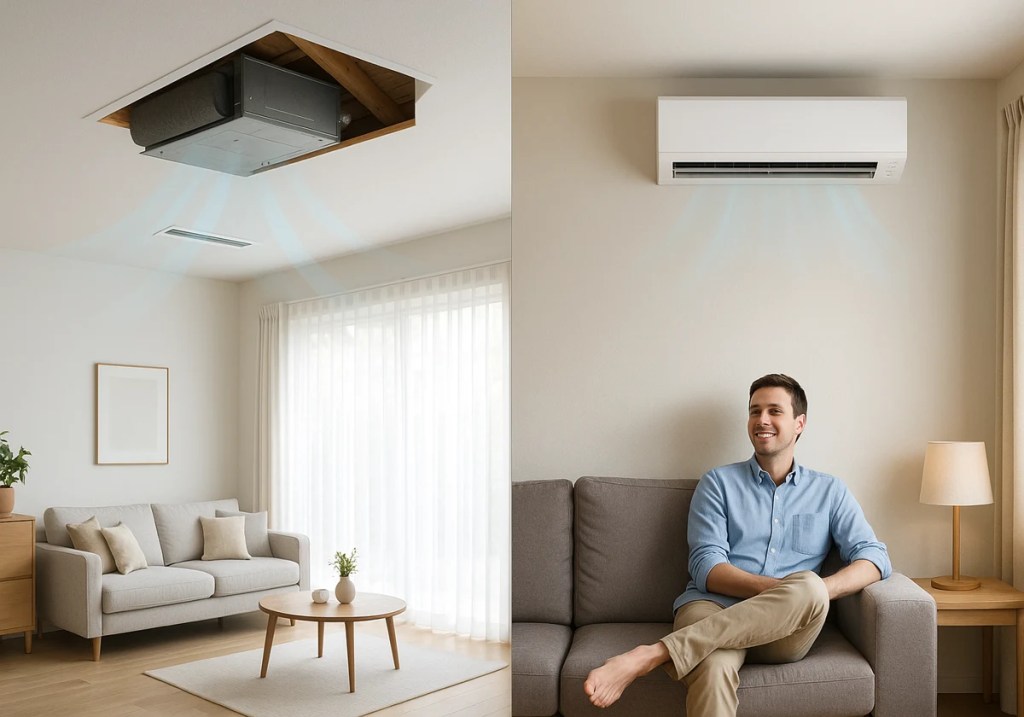
Ducted air conditioning delivers whole-home comfort from a single hidden unit. And split systems cost you half as much upfront and work better when you only need partial coverage.
Most buyers struggle with this decision because both reverse-cycle air conditioners have real advantages. Here’s how they are actually different from each other:
Factor | Ducted Systems | Split Systems |
Upfront cost | $12,000–$18,000 | $6,000–$9,000 |
Installation | Needs roof access, ductwork, and often a 3-phase power system | Wall mounting, pipe to the outdoor unit |
Coverage | Whole house from ceiling outlets | Individual rooms, wall-mounted units |
Aesthetics | Hidden vents, clean look | Visible indoor units on walls |
Energy efficiency | Can waste energy cooling unused rooms | Cool only the rooms you’re using |
The verdict is: the right choice depends on your situation.
If you’re building a new home with ceiling space, ducted makes sense due to its coverage and hidden aesthetic look. Renovating an older place or renting? Split system air conditioners let you cool your place without major construction work.
Installation Costs For A Ducted Air Conditioner Explained

Installation quotes for the same ducted air conditioning system can vary by five to eight thousand dollars between contractors. Most homeowners don’t understand why until they’re locked into a contract.
Let’s have a look at the mandatory installation cost that you should consider before buying a ducted air conditioner.
Roof Space Access Increases Labour Costs
If you are having tight roof cavities, it means installers spend more hours feeding your ducts through cramped spaces. Your settings need to work in extreme heat, which slows down the entire ducted AC installation.
Beyond the heat issue, some roofs create even bigger headaches. For instance, Asbestos roofs need professional removal before any air conditioning system goes in, which adds an extra $3,000 to $6,000.
On the other hand, tile roofs cost more than metal roofing because installers must carefully lift tiles, cut access points, and reseal everything properly.
Three-Phase Power Upgrades Add Extra Expense
Those large reverse-cycle air conditioners need three-phase power to operate efficiently. But most residential homes only have single-phase power.
Check your switchboard before getting ducted air conditioning quotes. Electricians charge $2,000 – $4,000 for a three-phase installation. If you already have three main switches, you can skip this cost.
Quality Ductwork Prevents Efficiency Losses Later
Don’t use cheap flexible ducts. They leak up to 30% of your cooled air into the ceiling space before reaching rooms.
It’s a proven solution that proper duct insulation stops heat transfer in hot roof cavities. Because of it, the heat exchanger doesn’t work as hard, and your energy bills stay lower.
Hidden Running Costs Of Ducted Air Conditioner Ownership
You just paid $15,000 for your new ducted air conditioning system. Three months later, your electricity bill arrives, and it’s doubled. (Fustrating, right?)
Here’s what increases your running costs that installers never mention to you upfront.
Ceiling Insulation Affects Your Power Bills
Hot roof spaces transfer heat straight into your ducts. Then, the cooled air warms up before reaching your rooms below.
The problem happens when poor ceiling insulation forces your air conditioning system to constantly fight that heat gain. However, you can solve this problem by adding batts before installation, since adding batts after installation costs $1,500.
Thinking about ignoring batt? Well, that’s going to cost $400 extra on energy bills every year for the next twenty years.
Bad Zoning Choices Double Your Electricity Costs
During the day, cooling your empty bedrooms wastes half the energy a reverse-cycle air conditioner uses. We have seen most people leave all zones running because they don’t understand the controller.
Use smart zone systems because they automatically shut off air flow to unoccupied rooms. They also reduce your cooling costs by 30% without effort.
Maintenance Fees And Filter Changes Add Up
Professional servicing runs $200 to $400 yearly for ducted air conditioning systems. If you try to skip it, your energy efficiency also drops by 15%.
That’s why clean the return air filters every six weeks. It stops dirty filters from choking the air flow and forcing longer heating and cooling cycles.
Inverter Vs Non-Inverter Cooling Systems
You’ve sorted out sizing and installation costs. Here comes the technology choice that affects your energy bills for twenty years.
Inverter reverse-cycle air conditioners cost $2,000 more but reduce electricity use by 40%. The compressor adjusts speed based on your desired temperature instead of cycling on and off.
Meanwhile, non-inverter cycle air conditioners work like your old fridge. They blast full in cooling mode until the temperature drops, then completely off. Also, they switch between heating mode and cooling mode in rough jumps.
An energy-efficient air conditioning system saves $400 to $600 yearly on energy bills. Your extra $2,000 pays itself back in three to four years.
After that? You pocket the energy savings for fifteen more years.
Zoning Options For Your Ducted Air Conditioning System

How many zones do you actually need: two, four, or eight? It’s a common case that installers push maximum zones to increase their quote, but the wrong configuration wastes money upfront and on every electricity bill afterwards.
Let’s see what different zoning setups actually save you money.
Multiple Zones Increase The Installation Price
If you plan for multiple zones, then each one requires motorised dampers installed inside your ductwork system. These dempers control which rooms get cooled air and which don’t.
A four-zone ducted system costs $1,500, which is more than two-zone installations. Zones require controllers, which adds another $500 to $1,000, depending on features like remote controls and smartphone connectivity.
Empty Rooms Waste Energy Without Zoning
A Single-zone ducted air conditioning system can cool every room simultaneously. However, you’re paying to cool the entire house even when everyone’s in the living room. It’s a waste.
That’s why suitable zoning cuts energy consumption by 30% in typical family homes.
For your information: Bedrooms only need cooling in heating mode at night. Living areas need it during the daytime. Don’t mess up this routine.
Poor Zone Design Limits Future Changes
Caution! Zone motors installed in the wrong duct locations can’t be moved without major work. But the ducted system layout helps you here by locking into specific room groupings.
But be careful when you group the rooms, since doing it the wrong way creates temperature conflicts. Plus, it limits your redesigning in the future.
Wrapping It Up
In this article, you’ve got the knowledge installers won’t share upfront. Sizing mistakes, problematic ductwork, and wrong zoning choices won’t catch you out now.
Most homeowners spend months researching air conditioners only to miss the details that are actually significant. After reading this, you’re not those most homeowners anymore.
Ready to get your ducted air conditioning system done right the first time? At GTALLEN, we handle installations across Australia without the sales rubbish or hidden costs. Talk to us, and we will give you straight answers about your cooling system needs.

Recent Posts

Common Mistakes Homeowners Make When Installing Air Conditioning
When you hire an air conditioning installer, you usually step …Read More »
Energy Efficiency Trade-Offs in Modern AC Systems
You’re standing in front of two split system air conditioners …Read More »
Why AC System Design Matters More Than Brand Choice
Your AC system design is more important than brand choice …Read More »
What a Proper In-Home AC Assessment Actually Covers
A proper AC assessment covers a full check of your …Read More »
Planning AC Installation Around Seasonal Demand
Did you know that AC repair searches spike 266% during …Read More »
